Act II: Scene 3
Summary
This scene is set in Shylock's house. We see Jessica, Shylock's daughter, speaking with Launcelot, and she expresses her sorrow that he decided to leave his position as her father's servant. She’s unhappy at this separation. "Our house is hell," she says, "and thou a merry devil / Didst rob it of some taste of tediousness." She passes him a letter to deliver secretly to her lover Lorenzo "who is thy new master's [Bassanio's] guest." After Launcelot leaves, we discover that Jessica is planning to elope with Lorenzo, a christian companion of Bassanio. She is planning to deliberately leave her father's faith and become a Christian marrying Lorenzo.
Analysis
This brief scene in Act II introduces the audience with Shylock's daughter, Jessica.We also come to know about her relationship with her father. Her plan is to leave the old moneylender's house; she says, "Our house is hell." Her observation gets some justification as we have been already introduced with Shylock’s nature through Antonio and Launcelot.
This scene makes the way to Jessica's elopement with Lorenzo. It adds irony to Shylock's multiple warnings to his daughter in Scene 5 to guard his house well.
In this scene, Shylock is cast in the dark role of a villain. Jessica's remarks paint her father Shylock to be a heartless unkind man. Interestingly, even though Jessica's intention to leave her father's household and rush into her lover's arms seems natural enough, Jessica is aware of her "sin," being her father's child. Mark the contrast between Portia and Jessica. Portia is loyal in contrast to Jessica as far as the Electra complex is concerned.

Act II: Scene 4
Summary
Gratiano, Lorenzo, Salarino, and Salanio discuss their plans for Bassanio's dinner party and masque that night prior to his setting out for Belmont. It’s going to be a special night. Gratiano is assigned the task of merry making. He plans a masque and he further assigns it to Lorenzo who is a good organizer for such an event. He has completed the preparation in his mind. Everything is in order. Only “Torch bearer” is missing and he is looking for one page boy to become his torch bearer.
While they are talking, Launcelot enters, on his way to invite Shylock to the party, and he delivers Jessica's letter to Lorenzo. Lorenzo reads it and sends Jessica a reply: "Tell gentle Jessica / I will not fail her; speak it privately." Lorenzo then tells his friends that he has found a torchbearer. In private, he confides in Gratiano that Jessica is going to disguise herself as a page and elope with him; furthermore, she will escape with enough gold and jewels for a proper dowry. She wants to settle with her husband elsewhere with this money. Lorenzo feels sure that Jessica, in a page's attire, can successfully disguise herself as a torchbearer for Bassanio's party and will not be recognized.
Analysis
Masque was a ploy to introduce the necessity of Jessica’s elopement. It never occurred. It was not the purpose of Shakespeare. He wanted to show the audience that Gratiano Salario etc did have active consent to Lorenzo Jessica’s elopement to the detriment of Antonio. They incited the incident to bring, rather hasten the misfortune on him. Reckless celebration and youthful frivolity of Venice is brought about through this scene. There is a subtle fear lurking in the possibility of Shylock’s discovering the theft. They know Shylock would unleash all possible resources to catch and punish Lorenzo- Jessica. Therefore, Jessica plans to go far away and secure themselves with the money and the costly stones. In their jest, Lorenzo, Gratiano and Salario seem to forget the serious impact such an act would impose on Antonio for, he is the merchant financier for all their trivialities.
Act II: Scene 5
Summary
While Preparing to leave for Bassanio's dinner party, Shylock encounters Launcelot, who has come to deliver Lorenzo's reply to Jessica. Shylock has accepted Bassanio’s invitation to keep his true intention hidden. He chides his former servant and says that as Bassanio's attendant, Launcelot will no longer be able to "gormandize" and "sleep and snore" as he was (theoretically) able to do with Shylock.
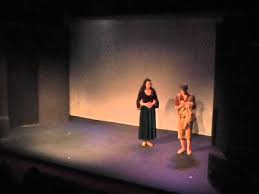
In between his speeches to Launcelot, he calls out the name of Jessica. When she finally appears, he gives her the keys to the house and tells her that he is going to attend Bassanio's dinner party. Grumbling, he confesses that he accepted the invitation "in hate, to feed upon / The prodigal Christian." He apprehends that he is "right loath to go"; he has a foreboding that "some ill [is] a-brewing."
Launcelot wants his former master to go. He does not think much. He seems to be singing in tune with his master to keep him pleased and formally release him of his services. He has been raised in the house of Shylock. In due course, he learnt a few witty remarks that the cultured humorous Venetians indulge in often. He babbles his "feeling" (because his "nose fell a-bleeding on Black Monday last at six o'clock in the morning . . .") that Bassanio is preparing an elaborate masque as part of the evening's entertainment. He should not have passed this information. His talkativeness without any inherent merit makes him do so.
Shylock is horrified at the suggestion that he may have to endure the flamboyant show of a Christian masque. He insists that if Jessica hears any sounds of the masque, she is to "stop up [his] house's ears," which means that she would close the windows. She herself is to keep inside and not "gaze on Christian fools with varnished faces [painted masks]"; he vows that no "sound of shallow foppery" will enter his "sober house." Despite grave misgivings, Shylock finally decides to set out for Bassanio's dinner party. He exhorts one final command for Jessica to stay inside: "Fast bind, fast find — / A proverb never stale in thrifty mind." Shylock exits.
Launcelot meanwhile whispers a quick word of advice to Jessica before he leaves: She is to be on watch for "a Christian" who will be "worth a Jewess' eye".
Alone on the stage, Jessica anticipates her impending elopement and utters a prophetic couplet that closes the scene:
Farewell; and if my fortune be not crossed,
I have a father, you a daughter, lost. (55-56)
Analysis
This scene expounds an additional tinge of colour to the character of Shylock. We know of Jessica's intended elopement, and thus we understand Shylock's sense of foreboding when he speaks of "some ill a-brewing." Shakespeare has always added supernaturalism in his Drama. He added Caesar’s ghost in “Julius Caesar”. Here also, Shylock gets the right premonition.
Launcelot, in his excitement and anxiety, almost gives the elopement plans away. He lets slip the phrase "They have conspired together" (22), but he immediately covers his mistake with some confused nonsense about his own prophetic dream; he predicts that there will be a masque at the party because his "nose fell a-bleeding on Black Monday." Launcelot diverts attention of the shrewd moneylender from the fear of losing money lest he should cancel leaving his house at the moment.
Also central to this scene is Shylock's concern with his possessions. There is his obsession with locking and guarding the house. He somewhat does not entrust his own daughter, Jessica. He calls her to him and gives her his keys, then almost takes them back again: "I am loath to go," he says. The emphasis is on the protection of his wealth. He says, "Hear you me, Jessica: / Lock up my doors," and it occurs again in "stop my house's ears — I mean my casements".
The idea of music entering his house is repellent to Shylock. He warns Jessica that perhaps he "will return immediately,". Shakespeare suggests Shylock's miserliness with the help of unspoken, grudging affection for his daughter and. He calls Jessica, affectionately, "Jessica my girl," and of Launcelot he says, "the patch [a kindly nickname for a clown] is kind enough."
The juxtaposition of Shakespear’s dramatic irony lies in our knowledge that while Shylock is concerned with his valuables, it is his daughter that he is about to lose, and it is unto her that he entrusts his possessions.
Disclaimer: The images have been taken from Google's sites.


