Search This Blog besttutorskolkata.blogspot.com www.dbhattacharjee.com

Showing posts with label ENGLISH STUDIES IN INDIA. Show all posts

Monday, April 10, 2023

Dance Like a Man, Mahesh Duttani, Indian English Drama, English studies in India, BA (English Honours), MA English


Dance Like a Man By Mahesh Duttani


Born on 7th August, 1958 in Bangalore , Mahesh Duttani is an intellectually stimulating Sahitya Academy Winner . Dattanis play script casts its focus and locus entirely on the urban space, specifically rooted in the dynamics of domestic space. Mahesh Dattani is a Bangalore based dramatist and director. The themes of his plays have attracted the attention of a great number of readers and audiences in theatres. He has tried to bring hidden issues of society such as plight of women and transgender, gender discrimination, homosexuality child sex abuse etc. into light through his plays. He has shown the problems of city life in India in a significant manner in his plays. He has a striking artistic mind that makes him different from other dramatists.


The play Dance Like a Man is a stage play in two acts. The play was first performed at Chowdiah Memorial Hall, Bangalore on 22 September 1989 as a part of the Deccan Herald Theatre. Traditional Dance, in the play, is a form or a tool that enables the writer to tell his story. This drama explores and analyses the gender discrimination in a society, the injustice done only on the term of gender and the preference given to a male child over a female in an Indian family. The play explores the nature of the patriarchical tyranny that even men might be subject to.


In this two-act play, Dattani has tried to knit the story around three generations and their conflicts. The play deals with issues like problem of marriage and career, conflict between the tradition and modernity, patriarchal domination, plight of devdasis, gender roles etc.


Dattani portrays an Indian family in which Amritlal Parekh possessed unquestionable power over Jairaj and Ratna. The action of the play takes place in the big house of Amritlal which is located in centre of the Chennai city.  The drama was written in flash back mode.  Presently, the characters are Jairaj, 62 year old and Ratna, his wife ageing 60; Lata, their daughter, Viswas, her would-be-husband and Amritlal, Jairaj’s father. Amritlal Parekh being the head of the family, he declared himself to be responsible head for taking important decision of all their life. Amritlal as a father wishes his son to have the best, he also worries  that  his  son’s  choices  would  not  make  him anything if he pursued  them any  longer. He  gave his  son the freedom to practice dance instead of cricket as a young boy but he was worried when the hobby for dance as a boy grew into a passion for Jairaj as an adult. Jairaj desired to take his passion for dance as his profession and that would lead his son nowhere and he would not be able to support his family in future. Amritlal feared that his son, unable to take the role of man by the social norms, would fail to win the  love  and  respect  a  wife  has  for  her  husband. 


Amritlal was a reformist and freedom fighter yet a prudish and conservative. He supported India to get freedom from the Britishers. Ironically he controlled and framed strict regulations over his own son’s wishes. He rejects the freedom of his son who wanted to become a Bharatnatyam dancer. Father implements his wish on his son and wants him not to take up dance as his career because it is not a ‘male oriented’ profession. For Jairaj, Dance is a form or a means to express emotions and stands as the tool of defiance, revolt, negation of a particular way of life that was decided by his father, Amritlal. He starts dancing as a hobby.  Dance for his father is the profession of a prostitute, improper for his daughter-in-law and absolutely unimaginable for his son. He forbids Ratna from visiting the old devdasi who teaches her the intricacies of bharatnatyam. He cannot tolerate the sounds of the dancing bells that ring through their practice sessions. Jairaj becomes more headstrong because of the support of his wife, Ratna who also was interested in traditional form of dancing.  Amritlal dislikes the long-haired guru with an effeminate walk and cannot, most of all tolerate the idea of his son –a man- becoming a professional dancer. Amritlal Parekh makes a pact with Ratna. He will permit her career in dance only if she helps him pull Jairaj out of his obsession and make him a ‘manly’ man. Amritlal knew that dance would not help Jairaj to earn enough money and that would make him unworthy in the eyes of his wife Ratna. For Amritlal, dance was good as far as it remains a hobby but it was not proper to be taken as a profession.  Jairaj and Ratna both with a common passion for dance are victims of Amritlal the patriarch of the family. Even after Amritlal's demise Jairaj, his son cannot get rid of the expectations of his father which eventually leads him into depression and alcoholism. In contrast, Ratna at every stage cooperates with Amritlal for her benefit and pursues her passions till the end. Hegemonic masculinity norms can be traced to society's pressure on women to be groomed and look desirable. Man is declared to be the bread earner and he is expected to be in such a profession in which self-esteem is concerned with it, in Indian society. In the other term, man did not get freedom to pursue the profession of an art form like Bharatnatyam. Jairaj’s father equates the art of dance with prostitution.


Dance Like a Man is a play that does not present the character as pure White or Black but it shows their different shades in all possibilities. Jairaj, the male protagonist of the play becomes a victim of gender restrictions. Usually women become victims or suffer due to the patriarchal culture. But this play focuses on the plight of a male who tries to break the conventional roles allotted to his gender by the society. In this process, he loses his identity as an artist in society. Jairaj’s dreams are shattered as his father considers that Bhartanatyam is an effeminate thing that belongs to female gender. 


Shallow materialistic values of art and life v/s old spiritual values


The play deals with the conflict between art and society. It also focuses on the sense of competition among the artists themselves. Young Jairaj and Ratna are practicing dance in the house of Amritlal Parekh. He is representative of the society of the nineteen thirties and forties. In the earlier days Bhartanatyam was associated with temples and rituals. The art was preserved by Devadasis. They were the professional dancers in temples. They were exploited by the priests and rulers. Finally, due to the economic needs these people turned to prostitution. So, the dance form was ignored and neglected till nineteen thirties and forties.


In order to protect and continue any art form, the artist should raise above human weakness. It is a state of human consciousness that wraps up the distinction of male and female into a state of ‘wholeness’. In his self-discovery, Jairaj discovers that the divine essence of human self is neither male nor female. Gender discrimination is integrated in human consciousness and is closely associated with individual choices, self development and self-identity.


PORTRAYAL OF RATNA


The play tells the story that revolves mainly around Ratna, her aspirations as a good dancer and a good mother who expects perfect dancer in Lata. Her dominance over her husband is exposed by the playwright. Lata wants to marry Viswas and to gain favour of her parents, she invites Viswas to her house. When Jairaj and Ratna arrive, though late, they discuss about the forthcoming dance competition of Lata and her preparation. There is no harmony in their married life, both of them want to see Lata a winner and get selected for the Canadian festival. They are talking about mridanist (musician) whose arm is broken not paying attention to Viswas. Later, they apologize for their behaviour and accept his proposal on one condition that he will allow Lata to dance after marriage. Lata wins the competition and both the parents are overjoyed. They read reviews of appreciation by critics in the newspapers about Lata’s performance and speculate over her selection for the Indian Festival in Canada. By the use of flashback technique, the playwright reveals the past of Jairaj and Ratna and their confrontation with Amritlal, Jairaj’s father. Amritlal does not like Jairaj’s passion for the dance, especially for Bharatnatyam. He does not like Jairaj’s idea of growing hair long. He expects his son an adult and grown up and in this matter he expects Ratna’s help. But both Jairaj and Ratna never respect Amritlal’s selfish opinions. They leave the house impulsively but come back after two days humiliated, accepting Amritlal’s shelter. But during these two days, all the three are changed and some sort of transformation is sought in them. Amritlal is ready to pay Jairaj and permits and advises him to perform dance as a profession. He asks Ratna to help him making Jairaj an adult and grown up and that he will permit her to dance. The play ends on a happy note that both Jairaj and Ratna despite earlier differences get mutually united and they perform the dance in the heaven without missing a step or a beat.
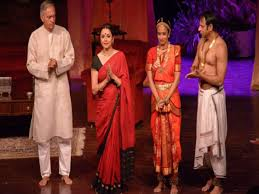


Ratna seems to be a selfish woman altogether, a woman of self-esteem and over-ambition. This is also displayed in her relationship with her daughter and an infant son. When she is young, she practices hard to gain perfection in dance. She all the time thinks to win appreciation of the audiences. She forgets her motherly duty towards her infant son, Shankar. She along with Jairaj goes for night performances keeping Shankar in the custody of ayas who offers him opium to make him sleep for more time and the ayah gets long peaceful sleep. She finds Shankar died of overdose of opium. She accuses Jairaj for that also and expected him at home near Shankar when she performed in the public. In her youth, Ratna cares only for the dance and her appreciation by the others. She neglects even her motherly duties. In contrast, when she is old, to be precise 60, she cares for her daughter and her performance. As a good mother, she dreams her daughter successful. She takes hard efforts for that also. She proudly tells Jairaj about Lata’s success and decides to take very serious efforts for her daughter’s success. Ratna is portrayed as a woman who is more concerned with her own career than her duty to the family. In an Indian family system, it is important on the part of a woman to perform dual or plural duties. She has to maintain her self-interest as well as perform roles of sister, daughter, mother, mother-in-law, sister-in-law etc.


Disclaimer: Images have been taken from Google sites.

Tuesday, March 8, 2022

PORTRAIT OF A LADY, ENGLISH LITERATURE, CBSE, Q ANS

 PORTRAIT OF A LADY

How long had the narrator known his grandmother? What was the opinion of others? What was the impression of the narrator ?

Since the days of writing this biography, the narrator had known his old and wrinkled grandmother for the last twenty years. She looked very old indeed. It seemed to her that she could not have looked older. People said that she had once been young and pretty (but, he would hardly believe it !!!). They said that she once had a husband. The narrator found it hard to believe as he could not somehow compare the extremely older look of his grandfather in his photograph with the wrinkled look of his grandmother. Little Khuswant’s assessment of beauty is evident from his childhood observation.

How did the narrator’s grandfather appear to him in the portrait?

His grandfather looked very old. He had a long white beard. His clothes were loose fitting. He wore a big turban. He looked too old to be married to have a wife and children. He looked at least a hundred years old. Little Khuswant thought that he was fit to  have only many grandchildren.

Which thought about the grandmother was often revolting and for whom?

The narrator’s grandmother was very old and wrinkled. In the eyes of Little Khuswant, she had stayed at that stage for the last twenty years. He remembers others saying that once she was young and pretty. The narrator couldn’t even imagine her being young. So the thought was revolting to him. The narrator’s grandmother was terribly old. She could not appear young and beautiful. Her face was a criss-cross of wrinkles. She was short, fat and slightly bent. The very idea of her being young and pretty did not appeal to the mind.


The narrator’s grandmother ‘could never have been pretty, but she was always beautiful’. Explain the the statement.

To littel Kuswant, her grandmother looked too old to appear pretty. Her face was a criss-cross of wrinkles. She was short, fat and had a stoop. She was not at all beautiful. However, in her spotless white dress and gray hair she was a picture of serenity, peace, sobriety and beauty.

The narrator’s grandmother looked like the ‘winter landscape in the mountains’. Explain.

The narrator’s grandmother was always dressed in spotless white. She had silvery hair. Her white locks would spread across her shoulder untidily and also over her pale and wrinkled face. She looked like an expanse of pure white serenity. The stretch of snow over the mountains looks equally white and peaceful on top. So her silvery locks and white dress made her look like the winter landscape of the range of the mountains.

How did the narrator and his grandmother come close to each other?

During Khuswant’s childhood, he stayed with his grandmother in the village in their ancestral house while his parents were settled in the city. She was his constant companion. She looked after him. She used to wake him up. She got him ready for school in the morning. She would give him breakfast. She went to school with him. She told him bed time stories from Ramayana, Mahabharat etc.

Why couldn’t the grandmother walk straight? How would she hobble about the house?

The grandmother was short and fat. She was also slightly bent. She put one hand on her waist to support the stoop. She could not walk straight. She walked like a lame person. She limped or hobbled about while moving.

How would the grandmother spend her time while the narrator would attend his class at the village school.?


The grandmother went to the school with the narrator. The school was attached to the temple. The school was a make-shift one at and was at the backyard of the temple. The priest’s part time occupation was teaching the village’s kids. The narrator would learn the alphabet and morning prayer at school. The grandmother would sit inside the temple. There she would read holy scriptures. Thus she spent her time before they would return home together.

How can you conclude that the Grandmother was a religious lady?

Khuswant’s grandmother visited the temple every morning and read scriptures. At home she always mumbled inaudible prayer and kept telling the beads of rosary. Her lips would murmur in silent prayers always. She would sing God’s name in a sing-song manner while getting the narrator ready for school. All these details create the impression that she was deeply a religious lady.


The grandmother had a divine beauty. How does the author describe in his writing?

The grandmother’s silvery locks scattered untidily over her pale and wrinkled face. This made her look like an expanse of pure white serenity. She had a divine aura around her. She looked like the winter landscape in the mountains. Her lips would mutter in God’s name constantly while the rosary beads would be counted in her hand always.

How would his grandmother look after her grandson in this story?

The grandmother woke him up in the morning, got him ready and took him to school. She prepared his wooden slate. She waited in the temple while he studied in school. She told little Khuswant the epic stories from The Ramayana and Mahabharata. She would take him to school and they returned home together.

The grandmother was a kind-hearted animal loving woman. Give examples in support of your answer.

Grandmother had a very kind heart. She loved her grandson. She loved birds and animals. In the village, she fed the street dogs. In the city, she would feed the sparrows.

“That was a turning point in our friendship.” Explain this remark?

The turning point in their friendship came when Khuswant and his grandmother shifted to the city. Now the narrator went to an English school in a bus. Grandmother could no longer accompany him to school. Although they shared the same room, they saw less of each other. Back home, he would be busy in his studies. The grandmother did not quite approve of the convent style of studies. She would not interfere in his studies either. They shared the same room, but their speech interactions came to a halt.

Which difference do you find between village school education and city school education?

Elementary education was given in village school. The pupils were taught the alphabet, basic numericals and multiplication tables. It was quite simple—confined to reading, writing and arithmetic. In the city school, English, Science and Music were taught. Unlike village school there was no teaching about God and scriptures.

Why was grandmother offended to the narrator receiving education in English school?

She did not believe in the things they taught at the English school. She hated the Western Science and learning. She was pained to know that there was no teaching of God and the scriptures there.

What led to the gradual distancing of the narrator from his grandmother in the city? Give three reasons.

As the years rolled by, the narrator grew older. His dependence on grandmother became lesser. He started going to an English school in a motor bus. She did not need to accompany him any longer. Moreover she couldn’t help him in teaching English and Science. She hated English school. In the convent syllabus, there was no teaching about God and scriptures there. 


Why didn't the narrator's grandmother like music? Why was the grandmother disturbed when she came to know that music lessons were being given at school?


She considered music having lewd associations. It was not meant for decent people and gentlefolk. She considered it to be the monopoly of prostitutes and beggars.

How did the common link of friendship between the narrator and his grandmother finally snap?

The narrator went to the university. Now he was given a room of his own for his personal use and studies. This separated the narrator from his grandmother. The common link of their friendship was thus finally broken.

How would the grandmother spend her time when the narrator went up to university?

The grandmother of Khuswant now lived alone in her room. She accepted her solitude quietly. She was now always busy with her spinning of the rosary bead. She always spent time reciting prayers. She hardly talked to anyone. In the afternoon, she would feed the sparrows. This was her only pastime.

Why/How did the grandmother start feeding sparrows in the courtyard of the city house?

In the village, she used to throw ‘chapattis’ to the street dogs. But there were no dogs in the streets of the city. So, she took to feeding the sparrows in the courtyard of their city house.

Describe how grandmother spent half-an-hour with the sparrows.

The grandmother usually fed the sparrows in the afternoon sitting in the verandah. She broke bread into little crumbs. Hundreds of sparrows would gather around her. They would chirrup noisily. Some would perch on her legs and shoulders. Some even sat on her head. She enjoyed feeding them. She never shooed them away. It was her happiest half an hour.

How did the grandmother see the narrator off at the railway station?

The grandmother loved Khuswant immensely. She became a recluse after arriving in the city. She would not venture outside. But, she broke this rule. When Khuswant went abroad for higher studies for quite some time, she broke her rule and accompanied him to the railway platform. She kissed the narrator’s forehead as her parting blessings. He cherished the moist imprint as perhaps the last sign-of physical contact between them.

What was the “last sign” of physical contact between the author and the grandmother? Why did the author think that to be the last physical contact?

On the railway platform, the grandmother kissed Khushwant Singh on his forehead. The author thought that this was perhaps the last sign of physical contact between them. He was going away for five years. She was extremely old and at her age one could never tell whether she would be alive to see him back.

How did the grandmother respond to the narrator’s homecoming from abroad?

There was a strange change in her behaviour. She was over-excited. She celebrated the arrival of her grandson. She collected all the women of the neighbourhood. For hours she continued singing and beating the drum. She had to be persuaded to stop to avoid overstraining. Perhaps it was the first time that she didn’t chant the mantra silently.

Narrate the death of the grandmother?

The grandmother realised that her death was near. She continued praying. Her fingers were busy telling the beads of her rosary. She lay peacefully in bed. She did not talk to anyone. After some time, her lips stopped moving. The rosary fell down from her fingers. She died peacefully.

How did the sparrows show their gratitude?

The grandmother lay dead in the room inside. Thousands of sparrows flocked to the verandah in the afternoon. They did not chirrup. Some of them sat as far as where she lay dead. They paid their last homage to the old lady silently. She used to feed them regularly. The narrator’s mother threw some crumbs of bread at them. They took no notice of them. As soon as the grandmother’s corpse was carried off, they flew away quietly.

Write a character sketch of the author’s grandmother,.

Khushwant Singh’s grandmother was a very old lady. She was short, fat with wrinkled face and a stoop. She would hold her waist to balance her stoop. Other hand would constantly count the rosary beads in silent prayers.She had white hair. She was very affectionate. She was closely involved in bringing up the author. The two lived in the village. She was a caring grandmother. She would wake him early in the morning and get him ready for school. She served him breakfast and took him to school. She waited for him in the temple. She prayed while he studied. She returned with him. On their way, she would give the stray village dogs stale chapaties.

She was kind and benevolent. She used to feed dogs in the village. In the city she took to feeding the sparrows. She was a deeply religious lady. Her lips were always moving in a silent prayer. She was always telling the beads of her rosary. She went to the temple and read the scriptures.

She was a strong woman with strong beliefs. Although she was not formally educated, she was serious about the author’s education. She did not approve of the western way of life, Science and English education. She hated music. She was distressed to know that there was no teaching about God and holy books at Khushwant’s new English school. Though, apparent and daily interaction with Khuswant stopped, she broke hers ecluse and came to the railway platform to see Khuswant off planting her blessing kiss on her forehead when the latter was going abroad for five years’ education. She celebrated his homecoming with excitement and merrymaking.


IMPORTANCE OF SELECTING "BENGALI" AS A SUBJECT AT XI XII LEVEL IN ISC CBSE CURRICULUM

  Hi, I'm Susmita . I've been teaching for about 30 years now. I taught at schools at the outset of my teaching career. So, you can ...